Showing posts with label Wedding ceremonies. Show all posts

Monday, August 22, 2011

THREE WEDDINGS


I have a faint recollection that a long time ago I read a serial in the Thamizh weekly 'Anantha Vikatan' --- a serial titled Washingtonil Thirumanam, penned by the famous Thamizh writer Saavi. I am sure many, particularly the members of that era, would remember the title I am referring to. It was a hilarious comedy describing how a South Indian Brahmin wedding was conducted in Washington at the request and funding of a top philanthropist of the US. With all the fanfare like a double Nadaswaram, and gaslights carried on the heads of the Korava (gypsy) for the Mapppillai Azhaippu. All the things needed for the wedding, including the Koravans and gaslights, were flown to Washington by special aircraft. Not only that, to make appalams expert Mamis, women who had the last word in the processing of high class appalams, were also brought to the capital so that they could be factory fresh!!

Expert, outstanding and famous cooks along with their big, big andas, cheena chattis and chatukam and karandhis (large enough to cook for a thousand guests) were also transported by air. Well, to make a long story short the wedding thus conducted was a great success, enjoyed by the whole population of the city. The Press, not to be left behind, gave a good coverage of the wedding!

The above story was published in the late 1960s, when US was out of reach to the common man. It was a dream come true for the first few Indians who were lucky enough to go to that country either as students for higher studies or officials sent on deputations and also for the diplomats getting posted there.

Now it is different. Every Indian household has at least one daughter or son settled there. Their children are no different from other children of other countries growing up there. Inter-marriages are common. Some prefer to come to their native place to get married, others get married in the cities where they grew up.

In June, there was such a wedding in Chicago. My grandson Kartik got married to Danielle, his friend of five years. It was a perfect wedding in every sense of the word, a pot-pourri of two cultures. There was no Mappilai Azhaipu, no vritham, no Kasiyathirai, no Mallai Mattal, no oonjal. There was a Sasthrigal (priest) who conducted the wedding in a very dignified manner with the bare essential rites such as the Vinayaka Poojai, the Kappukettal which the Sastrigal himself did both for the bride and the groom, the Kannika Daanam, recital of the Gothram and then the Mangalya Dharanyam or Thali kattu,( the ‘Mundru Mudichu) or Three Knots.
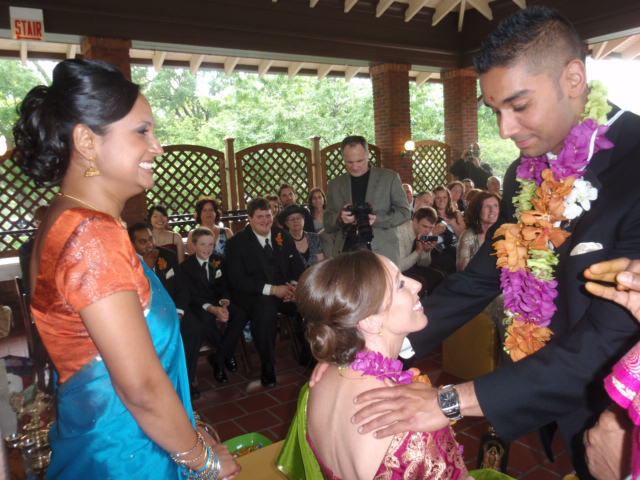
The first two knots were tied by Kartik, while the third knot was tied by Yamini, Kartik’s sister, as is the tradition. Yamini looked lovely dressed in a blue chiffon saree with a matching orange brocade blouse. The bride equally lovely and graceful was wearing a green chiffon sari and a pink brocade blouse, the groom in a tuxedo but no shoes. Next followed the other rites like the Saptha padi, Aseervadham and lastly the Aarathi.

The civil ceremony followed after a break for cocktails. While the guests were enjoying the drinks and meeting other friends, catching up with each other’s news, the bride and her bridesmaids absented themselves. Shortly, all the guests were seated at their respective tables – yes, there were about fifteen to twenty tables seating eight to ten people at each.

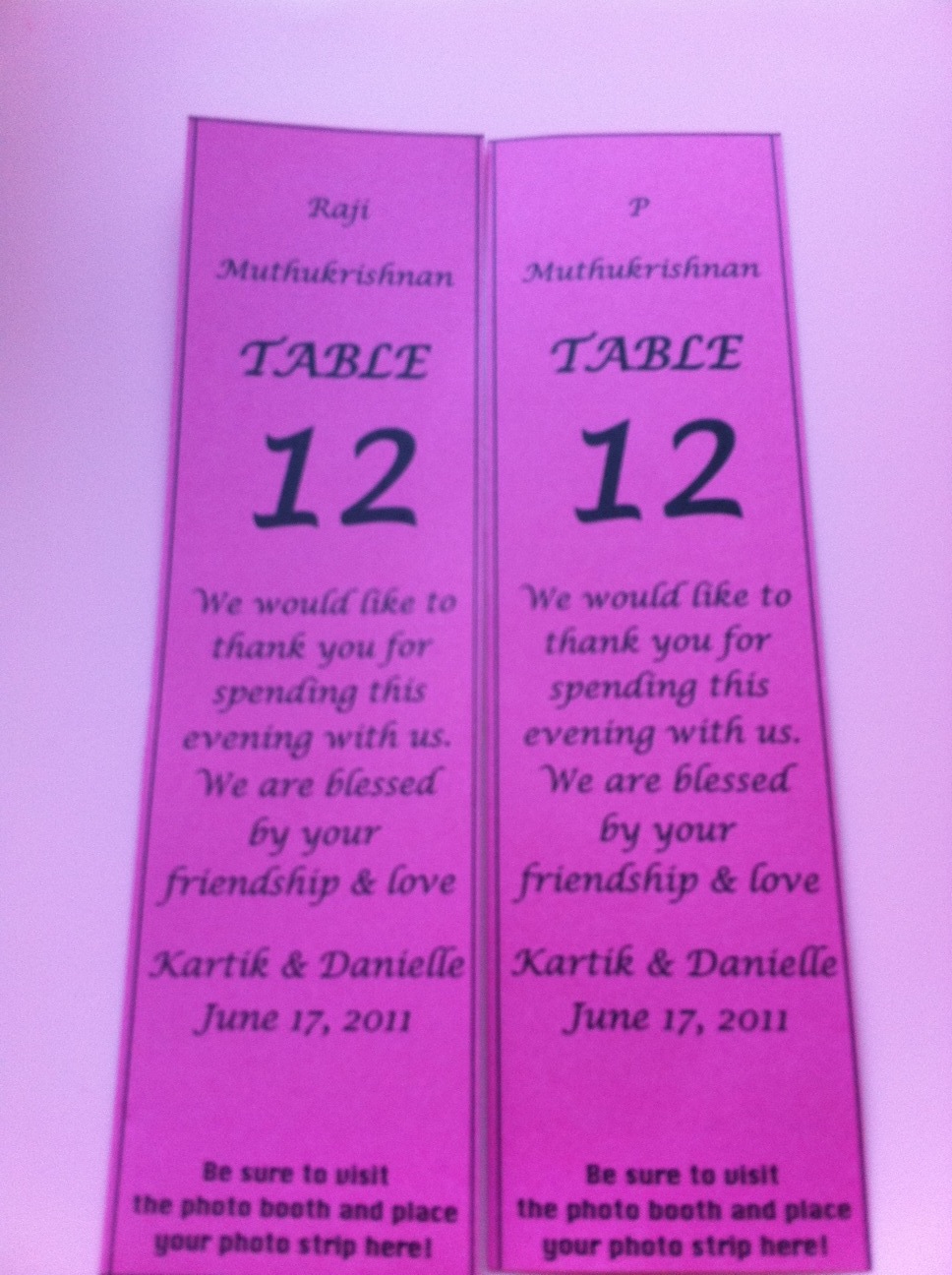
I really appreciated the way the guests were seated. Each table was labeled with the names of the guests, all members of each family in the same table. For example, my children and myself were at one table; the grandchildren were at another table; Jaishree’s mother and her brother, sister and niece with her family at another; known friends together likewise. Each one was made to feel at ease. The food, mainly north Indian, was served on individual plates.

Now, the bride in her really beautiful wedding dress walked down the stairs on her father’s arm followed by the two flower girls and bridesmaids, making a striking entry. From the other side Kartik and his Best Man walked in. It was a beautiful sight. The ceremony was conducted by a padre.

Both Danielle and Kartik took their vows, readily said the two words “I Do” without any hesitation, and exchanged rings. Most eyes (especially those of the parents) turned misty. The newly-married couple exchanged kisses and had the floor to themselves for the first dance as a couple. After this there were speeches, by Kartik thanking every one for their presence, and Jaishree saying a few words about Kartik, about how caring he is to everyone -- in Jaishree’s own words: “A caring son. a caring brother, a caring friend and now a caring husband to Danielle…”

It was then time for every one to get on to the dance floor. Not only youngsters but slightly older couples -- Raji and Muthu, Jaishree and Bala -- also joined them. I felt very happy to see them all enjoying themselves.
I was also thrilled to see three and little girls – seven-year-old Maya and Arundati, and two-year-old Samyukta (three f my great granddaughters) dancing and prancingo all over the place, sometimes by themselves or with any willing partners. Maya’s wish was granted when Kartik found time to dance with her.

Unlike the Washington wedding, for this Chicago wedding there was no need to get anything from India,. There are many outlets in Chicago where one gets all that is needed for any of our functions including the Kalasam and mango leaves!

Two days before the wedding there was a Mehendhi evening organized by Jaishree, in which many relations and friends including the bride’s relations and friends also took part. There were two professionals, girls from India, who did a great job of doing the designs on the hands and feet of children and ladies eager to have it done. Throughout the whole evening there was singing and dancing and merrymaking followed by a very tasty north Indian dinner.


On the wedding eve, Danielle and Kartik hosted a dinner for their relations and friends. This “Rehearsal dinner” (as it is called) for the relations and friends who have come to attend the wedding, was at an Italian place. After the dinner, speeches were made by Bala, Shaun -- one of Kartik’s friends -- and the young brother of Danielle. This was followed by Danielle and Kartik giving gifts to their parents. The bridesmaids too received gifts from the bride. An aunt of the bride was also very generous with her gifts to the parents of the bride and groom, and also to the bridesmaids

The evening and the dinner came to an end with the Ramakrishna clan singing “He’s getting married in the Morning”.

To be continued…..

Friday, July 24, 2009

THE MAIN CEREMONIES

Continued from previous post .. . . .
The bride waiting at the pandal welcomes the bridegroom with a garland, and he in his turn, garlands the bride.

Exchanging garlands at daughter Raji's
brother-in-law Chandran's wedding, 1976


In those days, since both the bride and the groom were children, the maternal uncles came forward to lift them on their shoulders. Sitting on the shoulders, the bride and the groom exchanged garland three times. This way everybody present could see them well and proper exchanging garlands. The uncles had more fun ducking and withdrawing to make it difficult for them to garland each other.

After getting down from the uncle’s shoulders, they were asked to hold hands and led to a flower decorated oonjal (swing). Here the priest got a chance to show off his musical prowess by singing the first oonjal song, and making way for the ladies to continue the singing.

Oonjal at Viji's wedding,1974

After each song, the nadaswaram player played the song faithfully on his instrument. This usually used to go on for half an hour or so. After this the couple was fed with banana pieces soaked in milk by the elderly Sumangali women. This was followed by the 'pachapdi sutthal' to ward off all evil eyes. The rice balls used for this are made with cooked rice mixed with turmeric powder and lime, giving it a red colour.

The most important part of the wedding is the ‘kanniga danam’ – giving away the bride. The bride’s father sat on a small bale of hay, with his daughter on his lap. She held betel leaves, a coconut and betel nuts in her cupped palms. The priests from both sides recited the lineage of the bride and the groom for three generations – the great grandfather, grandfather and father, along with the gothram thrice. This is a very touching moment, with the nadaswaram falling silent as well as the people. This was the moment when the bride entered the bridegroom’s gothram. The bride was then given away by her parents to the groom to be under his care, to the chanting of mantras.

Next came the presenting of the 'koorai pudavai', the traditional nine yard saree, the main wedding saree to the bride by the groom.

Giving the koorai pudavai at
Raji's brother-in-law Sivasu's wedding, 1972


While she went in to change into her new saree with the help of the groom's sister and other ladies, the bridegroom was seated on the same bale of hay (today the chair has taken its place), and the bride’s father washed his feet with the water being poured by her mother.

Babuji and I wash the groom's feet
at daughter Gowri's wedding, 1986


This was how the guest was received traditionally into the house by the host. The bride entered wearing the new saree with her sister-in-law, looking beautiful and looking forward to a happy life She was seated again on her father’s lap, who now sat on the bale of hay. While the priests chanted mantrams, the bridegroom placed a small yoke on her head, symbolizing that they would have to work together for the success of the marriage. And after this the bridegroom tied the mangalasutra, or thirumangalyam threaded on yellow thread, round her neck. The first two knots were tied by him and the third knot by his sister.

The nadaswaram then went into what is called 'getti melam', playing rapid notes at a high pitch, and the thavil playing loudly to a vigorous beat, while flowers were showered onto the new couple. Sugar and candy sugar were distributed to everyone to celebrate. Members of the bridegroom’s family were given thamboolam with coconut.

Now the bridegroom held the bride’s right hand with his right hand, took the marriage vows, praying to Agni, God of fire, and other gods to bless them with long life and prosperity.

Sapthapathi at daughter Viji's wedding, 1974

The bridegroom now held the right big toe of the bride and thus walked seven steps all the while chanting the mantram which said she had become his friend and companion, and would remain together for life. This is known as the 'sapthapathi', the actual point at which they are truly wedded.

Offering pori at daughter Raji's wedding , 1967

Next, the couple sat in front of the holy fire, while the priest chanted mantras which the groom repeated. The bride’s brother helped him to offer ‘pori’ (puffed rice) to the homam, signifying that the brother would take care of the bride, if the need arose.

‘Odhi idal’, is an important occasion giving gifts to the wedding couple by the various aunts and uncles on both sides. The priests invoking the blessings of the gods, handed over the gifts to the bride or the groom, naming the giver and the amount, for usually the gifts were in cash. Coins of Rupee one and two denominations were gifted, because they were minted in pure silver. Nobody wanted their names to be left out. Even today this system is carried out in families who follow tradition completely.

After that it was time for ‘aseervadam’, blessings, with the chanting of the mantrams, all elders showered yellow rice on the couple, praying for their long life together.

Two ladies now took arathi to signify that the muhurtham was over. The bride and groom went around performing namaskaram (obeisance seeking blessings) to all senior relatives individually, one by one, unlike today , when it is usual a sabha namaskaram, a single one for all.


More to come. . .

Friday, June 19, 2009

THE BRIDEGROOM ARRIVES....

Continued from previous post

An important part of the wedding is the Mapillai azhaippu – introducing the mappillai or the bridegroom to the local residents and the bride’s relations.

Once the bridegroom’s party was well-fed and rested after their arrival, they were taken to the local temple in the evening to get God’s blessings. A pooja would be performed by the priest.

Inside the temple, the bride’s brother welcomed him with a garland and applied sandal paste on his arms and presented him with a new set of veshti. From the temple the bridegroom and the entourage were taken to the wedding pandal in a slow procession with the accompaniment of nadaswaram and gaslights. In the early days it was a procession on foot, with the bridegroom garlanded. But even here changes came over gradually, and the bridegroom was seated in an open coach drawn by slow trotting horses.

The decorated car at the wedding of my son-in-law's sister in the early 60s

When motorcars came on the scene, instead of the carriage, an open car, well decorated with flowers and festoons was used for this. And along with this change, the bridegroom’s veshti changed to western clothes – a suit with shoes to add. As the English culture seeped into our custom, this kind of procession was give up by many modern minded families. And nowadays it is practically obsolete, except in a few cases.

At my son Bala's wedding in the 70s

When the bridegroom’s procession reached the wedding pandal, he and his relatives were welcomed ceremoniously with aarathi and thamboolam by the bride’s parents, and conducted to the wedding dais.

Here the purohits were waiting with everything ready for the next ceremony, the formal engagement. The bridegroom was garlanded afresh by the bride’s brother.

I have no memory of my mother telling me if the child bride was seated next to the bridegroom. I have seen in one or two weddings of the 1960s, the bride was excluded from this engagement ceremony. She never came to the pandal. But later on as customs changed, the bride was brought to the pandal, well decked. She was received by the bridegroom’s sister with a garland and kumkumam. Later on the practice of gifting jewellery to the bride became a part of this ceremony.

Among the chanting of the sacred mantrams and the strains of the nadaswaram, thamboolam was exchanged by the father s of the couple in the presence of elders. This exchange was considered the formal engagement.

After this the bride and groom had to perform obeisance (namaskarams) to all senior members of both families, taking care not to leave out anyone. Otherwise this omission would be held against them for life, which was not uncommon in those days.

Once the nichiyathartham was over the bridegroom’s people were led into the house for dinner. Here banana leaves were spread on the floor, the food being served on them. And people would be seated on durries or mats to partake of the feast. This meal being the first of the actual wedding ceremonies, was a grand one with pal payasam boli and vadai, as well as many varieties of vegetables, chips and pickles.

After the meal the men and women would sit on different sides of the pandal and offered betel leaves and nuts to chew on. They were escorted back to the house arranged for them and left there for the night.

In those days the wedding ceremonies lasted five days. People generally had a lot of time on their hands, and the wedding season started only after the harvest. The only entertainment they had was a temple festival or a harikatha kalakshepham. So ceremonies like weddings and upanayanams were conducted for five days.
A five day wedding gave enough time for the bridegroom’s party to get over the tiredness of the onward trip, and ready them for their return trip.

On each day of the wedding all the meals had to be served with different menus with a different pradhaman (essentially a Kerala sweet dish prepared with jaggery and coconut milk) each time. Unlike today, pradhamans were served until everyone was fully satiated.

A certain decorum would be observed by the bride’s family to their sammandhis on all these five days. Early morning coffee, breakfast (idly, vadai and a sweet made with jaggery), and evening tiffin (sojji and bajji) were to be sent to the bridegroom’s place on time and in plenty.

For lunch and dinner, each time men and women from the bride’s family would go over to where the bridegrooms’ family was staying, taking thamboolam and accompanied by nagaswaram, and request each and everyone , without leaving anyone out, to come and partake of the meal. On the day of the muhurtham also, along with the thamboolam a sweet preparation made with milk, and paruppu thengai were included to invite the bridegroom’s people. The paruppu thengai is a sweet prepared with jaggery,roasted chickpeas and coconut bits, and shaped like a cone, a symbol of prosperity and progeny.

A word about the nadaswaram. Nadaswaram was and is an essential part of the wedding ceremony. The then famous Ambalappuzha Brothers were the artistes who played the nadaswaram at my sister’s and my weddings. During the mappilai azhaippu, nicihyathartham on the day of the wedding, would be non-stop music, and the scale wedding was judged by the name of the nadaswaram player.

In the 1980s when my youngest daughter got married in Delhi, the event manager had arranged for the nadaswaram players to come from the south. It was something novel in New Delhi and was appreciated by one and all. Many of our friends and acquaintances congratulated us on the grand wedding.


At the wedding reception of Gowri and Mohan (left), Babuji shares a joke with a guest.

More to come..
....