Sunday, July 29, 2012

THE LUSCIOUS LITCHI


The luscious fruit!

All of us have tasted and enjoyed the sweet delicious LITCHI fruits at one time or another. Those who have never tasted that fruit can’t imagine what they have missed. Those who have enjoyed that taste can never forget it. The pleasure of eating a freshly-plucked Litchi and sucking the juice out of it is simply heavenly -- more so if it is from one’s own front garden. I had the joy of this pleasure just two months back, at my daughter’s place, in north Bengal.

The fruit laden tree
The litchi tree stands majestically in the front garden, way back from all the flower beds, and holds sway over all it surveys. Just three-four feet up from the ground, it has branched off all round resembling an open umbrella, calling on children to climb on it and play hide and seek among its branches. With no child of tree-climbing age in the house, the tree stands alone housing various kinds of birds and insects.

This tree held a kind of fascination for me, with its fruits hanging so low that one could pluck them without an effort. I really loved watching it from the veranda while having my first cup of tea in the mornings. I am not ashamed to say that I used to get the urge to reach out and sit on the lowest branch – just three feet above the ground.  It always reminded me of my schooldays in Lakshmi Nivas, my childhood home in Thiruvananthapuram, where we had all kind of trees and various plants. Among these, I had my own tree, with very low branches; one of these was my usual place whenever I wanted to be on my own, far away from everyone else.


The tree after the fruits were gone
There are many types of trees in Gowri’s garden.  The VILVAM tree is the oldest one. The trunk of this tree is so big no two human arms could hold it – it needs at least two pairs of arms to grasp it. The Vilvam tree has special religious significance; it is used in Siva temples for archanai. Its leaves – it is a compound leaf with three leaves in one stem – are said to represent the three eyes of Lord Siva.

Then there are are palm trees, peepul trees and a large rain tree. Two of the palm trees have money plants creeping over their trunks, with leaves as big as elephants ears. Tall the palm trees may be, but because of this, they look dwarfed  when compared to other trees.

In addition, there are various fruit and flowering trees – such as lemon, starfruit, guava, a small mango tree, with a single fruit dangling among its branches, and an ARAINELLIKAI one. The last one belongs to the Gooseberry family, the fruits smaller in size with a sweet tangy taste.

The fruit laden branches
Among all these trees the Litchi tree was the one that really fascinated me, especially as I watched the flowers turn to fruit. The pity was I could not reach out and pluck an unripe litchi and eat it as I might have done with a green mango. I had to wait for Nature to ripen it.

Gathering the harvest
When these fruits started changing colour from a coppery greenish tinge to a full red coppery shade, this tree started attracting monkeys in the daytime and bats at nights. The skin and the seeds strewn on the ground all round the tree were proof to this Two boys were employed just to drive away the monkeys from the tree but I observed these boys were never seen when the monkeys appeared.  Were the boys neglecting their job or were the monkeys too clever for them? I don’t know.


In spite of these monkeys and bats, when the time came to harvest the ripe Litchi there was plenty, enough for the family, enough for the domestic servants and plenty more for the neighbours.        

Friday, March 9, 2012

MEDA


A month back Raja and myself were proceeding to Pradeep’s Khet for a lunch gathering. His farm is located in Haryana, beyond Gurgaon, near the Sultanpur Bird Sanctuary and as we approached it, Raja pointed out to a red-tiled roof in the distance and said, “Look Ma, there is the Meda”.


The Meda is Pradeep’s brainchild. It is a two-storeyed building, the ground floor in brick and mortar, the top floor all wood, as in any old house in Kerala., In fact, it was an old house from Kerala. Raja told me it belonged to some friends of his, who were selling it. On a whim, Pradeep decided to buy it and transport it to Delhi.


Panel by panel -- including the wooden floor, the doors, the veranda railings -- as also the rafters of the ceiling and the red tiles of the roof, were dismantled, packed and trucked to the Khet, where it was then reassembled.  It took a team of six Asaris  (carpenters), their leader a veteran traditional temple builder, more than two months to do the reassembly, two months when Pradeep looked after them with loving care, even getting one of their wives to come over and cook “special Kerala” food for them

Very proudly, Pradeep took me inside and showed me around just like parents show off their new-born babies.And he has every reason to be proud. The Meda is a heritage building from the outside, on the inside it glimmers with every modern convenience, even in the bathrooms.


And then there was this wrought iron spiral staircase which led to the first floor. On our way to the Khet, Raja told me that I might have to be satisfied with seeing the Meda from the outside as I might not be able climb this staircase.  But with Pradeep pulling me from the front and Raja prodding me from behind, I managed to do it. 

And how beautiful the upstairs was: the wooden floors, the cosy bedrooms, the long verandas on either side with their round wooden pillars. It made me feel as if I was back in a Kerala Tharavad.

With Pradeep on the balcony

It took me back to my childhood days and to my grandparents’ home in Karamanai—a cluster of Brahmin Agraharams with row-houses.  In those houses the outer walls were brick and mortar but the floors, the staircase and the partitions that divided the upper storey into two or three rooms were all constructed of wood. We children were always cautioned to play there without making any noise like jumping around or running about. And for us it was a treat to be allowed to go upstairs and hunt around among the hundred and odd things like old newspapers, utensils and other things stored there, with the thought that some day they would come handy.

 Among the many odd things that kindled our interest, were some wooden dolls –Marappachis of various sizes the tallest about ten to twelve inches in height and smallest not even two inches high. These dolls were our attractions there. They were whittled out of some dark brown wood and unbreakable. We used to have so much fun dressing up them in odd bits of rags and making chains for their necks with some Pasimani. Nowadays these Marappachis are seen only in the Bommai-Kolu during Navarathri.

As I am writing this one incident comes to my mind -- how I got the nickname Chothi. Even today I am unable to figure out the meaning of that word. This happened when I was three or four years old, on a visit to my grandparents’ home. I was warned against going up the stairs but ignoring the words of elders, I followed them up.  Having climbed three steps I tripped or lost my footing and fell down on my back with my right arm and elbow caught under my back! How I was taken to a bone setter and had my right arm in a sling for six eight weeks is another story. Well, my elder brother it was who started calling me Chothi because of my broken arm and that nickname stuck with me for a few years!

I have allowed my memory to wander away from the main point. I am afraid I have a box full of memories in my brain and like Pandora’s Box once opened, it is difficult to close it. Thank God: unlike Pandora’s Box my memory box is only full of harmless stories. 


Friday, February 17, 2012

SEVAI FOR DINNER

Plain sevai. Picture courtesy www.subbuskitchen.com

Today we had SEVAI for dinner. I had made Mor Kuttan with Chenai and Elavan which prompted Raja to prepare Sevai -- the instant ready-made type, which one has to immerse in boiling water for a few seconds and take out. And all you have to do is soak the Sevai in the Mor Kuttan and enjoy.

 Sevai and Mor Kuttan -- what a combination! It brings back memories from childhood. Not the instant, packed, ready-to-cook sevai — but freshly prepared, right from scratch, starting with grinding the rice. Making Sevai at home in those days without any electric gadgets was hard work. We children never thought how much time and energy was spent in preparing it, we were more interested in enjoying the end product.


My mother and my elder sister were very adept in preparing this dish. They used to make an occasion of this by inviting all the local family members to join us to savour the Sevai, with Mor Kuttan, Rasam, Appalam and Vattal -- all the side dishes that go well with the main dish. They were helped by my mother’s Mami to do all the hard work, who was always ready to give my mother or my elder sister, a helping hand.  

Mami was very good at preparing tasty dishes. The very memory of the ‘Karavadai’, she used to make makes my mouth water even after so many years. Kunjami as we used to call her was my mother’s youngest mami. As was common in those days her husband had a second (unofficial) wife with two children. So Mami, with her two children, was finding it a tough job to make both ends meet. By helping others in the kitchen, whenever wanted, she was able to take care of her two children with the extra income she earned. Mami was big built and real fat but that did not deter her from hard work like grinding in the Aatukkal.

In those days, most houses had an Aatukkal and Ammi fixed to the floor, either in the kitchen itself or in the work area next to it.  In most houses, there was also, in one of the walls, a hole two inches in diameter, three inches deep, and inlaid with an iron lining. We kids used to wonder about this hole in the wall and each one of us had our own explanation.   When asked, my mother  would respond with ‘wait and see’. And we had to wait till it was Sevai day to discover what it was for.

On Sevai day, Mami would enter the kitchen and take complete charge of things. Grinding the rice and all the work at the fireside was done by her. As my mother used to say someone should be in the kitchen to do all the walking and fetching things for her.  Mami’s first need was to get a good lota of coffee after which she made herself comfortable at the grinding stone to grind the well-soaked parboiled rice to a smooth paste.

Dough rolled into balls
The next step was to place the dough in a thick-bottomed pan over a low flame, allowing all the water content to evaporate. Mami would stir the dough in the pan continuously, while making herself comfortable sitting on the floor by the fireside. After that was done, she would use one and all in the kitchen to help her make the thickened dough into fist-sized balls. These dough balls were then either steamed or cooked in boiling water.

Now it was time to bring out the SEVA NAZHI, the Sevai-making apparatus. It was made of bell metal or brass and consisted two U-shaped parts, the top one sliding tightly into the lower one. The bottom of the lower one was full of small holes, like a sieve.  For the Sevai making operations to begin, the Seva Nazhi was fitted into a special wooden stool about two feet high one foot wide which a hole in the centre.

By now Mami would be in full form. She would ask for a big banana leaf which she would clean and spread on the floor in front of the hole in the wall. She would place the stool with the Seva Nazhi on the leaf. Placing the steamed dough balls one at a time in the lower part of the Nazhi, Mami, with all her power, would press down on the dough ball with the upper part. We children would shout with joy as thin strands of the Sevai would start falling on the green banana leaf.

A present-day sevai nazhi
Sometimes more pressure would be needed to press the dough balls down the Nazhi. For that a wooden pestle, about three feet long and with both ends capped with iron, was needed … and also the hole-in-the-wall. One end of this pestle was fitted in to the hole in such a way that its middle portion rested on the Nazhi. Strong hands would then press down the other end, squeezing the upper part of the Nazhi into the lower part, and thus forcing the Sevai out of the sieved bottom. A few times I had seen my elder brother giving a hand to press the pestle.

My mother by this time would have prepared all the other required side dishes.  We youngsters were now required -- only to relish the Sevai with them

   A lot of the Sevai would be left over after everyone had had their fill. Half of this would be soaked in  the leftover Mor Kuttan, the other half in the leftover Rasam. To have this for breakfast the next morning was a great treat for us -- the taste simply heavenly.

Who has the time and energy to prepare all this nowadays?  Isn’t it wonderful that we have the instant variety now: it helps old persons like me remember and savour delicious things of the past!

All pictures  - courtesy www.subbuskitchen.com


Thursday, December 22, 2011

KAZHUGU MALAI KURUVIKULAM - EAGLE MOUNTAIN AND SPARROW POND


 Last Sunday’s HINDU carried an article on Kazhukumalai, a small township in the district of Thoothukudi in South India. The name of the place, Kazhukumalai simply took me back to my childhood days.

A gramophone and (below) a plate. Pictures courtesy Internet.


Those were the days when people were unaware of things like electricity and running water at homes. No electricity means none of the modern conveniences one has today. The gramophone was the only luxury some homes could boast of, and ours was one of those. We had collected a large number of plates -- this was what records were referred to in those days. This gramophone was operated by hand, winding up the springs that make the record holder revolve, fixing the needle to the stylus (one had to change the needle after the first side was played, to play the other side) We children were not allowed anywhere near this. Not only that we, the youngsters had to beg and nag our elder brother to operate this for us whenever we felt like listening to our favourite songs.

My favourite list included one song which begins with the words, ‘Kazhuku malai  Kuruvi kulam’(Eagle Mountain  Sparrow Pond) - a song with two  stanzas. Even after so many years I felt happy when I found out I remembered the words. The song on the flip side of this record was very rustic, beginning , “Macha vandhidingo thirunalluku” (An invitation to the boy friend to attend a festival).These were not film songs  but common “Theru koothu” (street play) songs. As I write, so many of those songs come flooding into my memory. “Indru pole endrum namum Isan namam Pottuvome” (Let us ever sing the praise of  Isan the Lord); “Imayam muthal Kumari varai” (from the Himalayas to Kanya Kumari)  - this song gave a geographical description of India and also introduced Mahatma Gandhi as the great Indian leader. One Kuravar (gypsy) song I remember well is, “Koodai  Muram kattuvom” (Let us weave baskets)  Well I can add a few more songs to the list.   What I wonder is - could anybody of that era be able to remember these songs? Is there any collector of old  Thamizh  songs who have these in the collection?  I really wonder!!

These records were pushed back to the bottom shelf when songs of films like Chintamani,  ThyagaBhoomi  Seva Sadanam, Sakuntala,Balayogini  and Bhaktha Kuchela became very popular. We had a few Telugu and Hindi film song records also in our collection. I remember how people on the street would stop in front of our house to listen to the latest film songs played on the gramophone. My elder brother was an avid collector of all film songs because my mother really enjoyed listening to them in the evenings, for though they were film songs all most all of them were devotional ones.          

When the radio entered our home in the late 1930s the gramophone and the records were handed down to the youngsters and we felt very grown up when our nephews were at the requesting end, begging us to play their favourite songs

Now today only oldies like me think of these things and some days lose sleep also thinking about those “GOOD OLD DAYS.” My youngest daughter told me once that in everyone’s life there are those Good Old Days depending on their age and when life was smooth running for them easy going, without any care. Reading the write up on Kazhuku Malai gave me so much pleasure, it brought back all those old songs to the front of my mind.

How I wish I could sing them out loud and clear! But that is not possible because I can only sing out of tune which even ‘Bathroom singers’ will object to.


Wednesday, November 16, 2011

'THALAI DIWALI'


A Diwali rangoli, created by my granddaughters Parvati and Swati
This year’s Diwali was Danielle-Kartik’s Thalai Diwali, the Diwali they celebrate as a couple for the first time. I sent them a mail from which I quote two or three sentences:
“In those days – I am talking about 75 years back -- newly-married couples used to wait eagerly for Diwali, the reason being they had to wait a year or so to start living together as man and wife.
“The boy with his parents used to go his in-laws’ place to celebrate Diwali.  If they (I mean the newly-married couple) were lucky they would get a few moments to themselves, to hold each other’s hands and for some daring boys to steal a kiss or two!!”

Kartik and Danielle
 Thanking me, Danielle wrote back saying she enjoyed reading my mail, bursting out laughing when she read “steal one or two kisses”.


My parents

Well, life was indeed very different then. My parents got married when my mother was eight years old and my father 14 -- that was in 1902. They were together for 70-odd years, till 1972, when my father passed away. Through thick and thin, through ups and downs, through sadness and happiness they were together bringing up their seven children and settling them in life. They did not understand the word LOVE, for there was no such word in their dictionary, but they cared so much for each other in their own way. Both of them had shared their fears and anguish for each other with me.

My third sister , me and my eldest sister
My three elder sisters were married off when they were 12, 13 and 14, respectively. I was not even born when my eldest sister got married. She was older to me by 13 years. So I have no idea how her Thalai Diwali was celebrated. I was 10 years old when my second sister got married and went to her in-laws’ place within two-three months and was with her husband and his family to celebrate their first Diwali. Since they were living in the same city the whole family was invited for lunch and my sister and Athimbar were presented with new clothes.

With my second sister
Though we are Tamilians, we are third-generation families who have settled in Thiruvananthapuram (capital city of erstwhile Travancore state). We have been more influenced by the culture of Travancore and developed our own style of celebrating Diwali including the Thalai Diwali of newly-married couples.
When my third sister got married and moved over to Trichy with her husband before their first Diwali, gifts were sent to them.  I was in Delhi with my husband a month after my marriage. We were sent money to buy whatever we wanted. I was 17-plus when I got married in 1945 and that was regarded as rather late for a girl to be married off. When my 23-year-old niece’s marriage was put off till 1960 because she wanted to finish her graduation, so many comments were passed.

So customs and rituals were being changed to suit each family’s convenience and the times they lived in. 

Nowadays there are hardly any set rules and laws. That is only right. With each family having its members spread all over the world it is very difficult to stick to old rules. I feel each family should be given the freedom to celebrate the festivals as they choose to, in their own way. 
 .     

Tuesday, November 1, 2011

AN EXPERIENCE


This evening I was watching an old Tamil movie (20 years old).  In one scene, the heroine was choosing earrings in a jewellery shop by holding each earring next to her ears, in front of the mirror. She was unable to decide which to go for. As she was looking in the mirror, trying the latest dangling ones, she was surprised to see another face in the mirror, that of a young man, signalling that this type looks good on her. When she tried another pair, the face in the mirror showed his disapproval. The face in the mirror was all smiles again when she tried the first one once more. That made the decision for her and she bought those earrings and on her way out thanked the youth.

Courtesy Internet
This scene in some way reminded me of what I experienced in a shoe shop in a mall in Chicago this June. I was there with my daughter-in-law Jaishree who was keen on getting me one or two pairs of footwear. Considering   my age she made me sit in the waiting alcove saying she would pick up a few samples and bring them over for approval. I took a seat and looking around found a young man occupying another chair.  Out of courtesy I said ‘Hello’ and he too responded with a smile and a ‘Hello’.

A young woman came over wearing the slippers she had chosen for the young man’s approval. He gave a thumbs down sign and she went back to choose another pair. She came back with another pair which suited her feet -- black with aqua blue/green design. I liked that colour combination and that must have showed on my face. The young man just looked at my face and gave the girl a ‘thumbs up’ sign.  The girl walked back and after a short time came back wearing another pair which did not suit her at all (my opinion). The young man also must have thought so and he shook his head in a negative manner.

This charade went on for about half an hour when Jaishree came with a few pairs of footwear in her arms, apologizing for the delay and asking me to follow her so that we could check the size and for me to choose the ones I liked. I got up saying “Best of luck” to the young man. He looked back at me with disappointment written all over his face and said “What! Are you are leaving? I thought you would help me in deciding which shoes will suit my wife”. I knew he was only joking.

I really enjoyed that half an hour waiting for Jaishree.    

Tuesday, September 20, 2011

THREE WEDDINGS

Continued from last post

It was in the summer of 2010 Kartik proposed to Danielle, and she accepted while they were holidaying in Rome. As soon as the wedding date was fixed by Danielle we were all informed. I felt very happy and thrilled and wondered whether I would be able to attend the wedding.  As things turned out, I had to make plans to attend another family wedding before I could turn my attention to travelling to the US in June 2011.
Rajesh's wedding at Trichur

In the midst of mentally planning as to who would be ready to escort me to Chicago, I received a wedding invitation from Chitra (the daughter of my husband’s brother Viswanathan) informing me her sons were getting married in April this year; the eldest son Rajesh, on the second at Trichur; and Kartik, the younger one on the 17th at Trivandrum. We were all happy to get this news. I felt really happy for Chitra, who went through a bad phase when she lost her husband in a road accident a few years back. Both Rajesh and Kartik then were in their teens, still students. She herself was seriously injured with innumerable fractures.

It took many months and many surgeries for her to come back to an almost normal and healthy life. In spite of all this she brought up her two sons, as well mannered citizens, giving them very good education. With the moral support of her husband’s family and her own parents and brother, she was able to do this, all the while continuing to work in a bank. What I admire in Chitra is that she has no self pity and she has come out of her ordeal as a very brave person.

A few days before I got the invitation, I had been told by Viswanathan that Rajesh’s marriage was more or less settled, the boy-meet-girl being over and only a few minor details to be finalized. But Kartik’s wedding taking place immediately afterwards surprised me.

 When I called Chitra to congratulate her I got to know why. Kartik’s was a love marriage. He had met Parvati when he was a final year student doing his Engineering course and she was a fresher. Maybe it was love at first sight. Once Kartik finished his studies and moved away from Trivandrum they had no chance of seeing each other. They kept in touch through letters and mobiles and decided to be together for life. Chitra gave full support to them on one condition - that they get married only after Rajesh got married. Kartik by this time had started working in San Francisco and settled there.  Now that Rajesh’s wedding was fixed, Chitra felt that there was no reason to make Parvati and Kartik wait any longer.

A wedding in the family and that too in Trichur, was carrot enough for me to decide to go there. So it was for Raji, Muthu and Raja. And we were off to Trichur; we had a grand time enjoying the ceremonies which lasted two days. Yes Rajesh’s wedding was a typical South Indian one with the vritham and the kappu kettal for the bride done side by side the morning before the day of the wedding, and the reception the same evening.

Till a few years back the trend was to hold the reception in the evening of the actual wedding day, after the thali kettal, and ammi mithikkal —the main and important rites of the wedding. Nowadays, to suit the conveniences of renting the wedding hall, the reception is held on the wedding eve itself!

Whatever that may be, the general opinion of this wedding was that   “Trichur has not witnessed this grand a wedding in the recent past”.  Without doubt it was one, with live nagaswaram and typical Kerala cuisine, with different menus for each meal for two days.  Not only that, the wedding hall -- a big one -- was packed to its full capacity. An indication of how popular Chitra is in her workplace was the fact that her colleagues at the bank in Ernakulam,  80km away, all turned up for the wedding, from the manager down to the security man.
At T. R. Rama Iyer's cloth shop
We four from Chennai had a good nostalgic time in Trichur, apart from the wedding, visiting old places and landmarks and of course praying at Vadakkunathan Temple and Thiruvambadi Temple. We also visited the cloth shop which still bears the name of my husband’s uncle’s ( T R Rama Iyer) and made some purchases.

Kartik's wedding at Trivandrum. Chitra is seen on the left - in the brown saree.
We were unable to attend Kartik’s wedding.  I was told that Kartik’s wedding was a one-day affair with the pudava koda   in the morning and the reception the same evening.  Yes, the Nair wedding is known as the pudava koda- (gifting a pudava by the bridegroom to the bride).  The wedding rites take only half an hour or so.

The bridegroom was received by the bride’s brother and seated at the dais where the bride joined him. After receiving the mundu nerithu from the bridegroom, they exchanged garlands and rings. There was no vritham no malaimattal no oonjal. I was told the wedding feast was a large spread with all the Kerala special prathamans and vegetable dishes.

Three weddings in the family of Trichur Ramakrishna Iyer, great-great grandfather to the three bridegrooms.  Each one was conducted differently, but thoroughly enjoyed by one and all.   

Concluded    


Monday, August 22, 2011

THREE WEDDINGS


I have a faint recollection that a long time ago I read a serial in the Thamizh weekly 'Anantha Vikatan' --- a serial titled Washingtonil Thirumanam, penned by the famous Thamizh writer Saavi. I am sure many, particularly the members of that era, would remember the title I am referring to. It was a hilarious comedy describing how a South Indian Brahmin wedding was conducted in Washington at the request and funding of a top philanthropist of the US. With all the fanfare like a double Nadaswaram, and gaslights carried on the heads of the Korava (gypsy) for the Mapppillai Azhaippu. All the things needed for the wedding, including the Koravans and gaslights, were flown to Washington by special aircraft. Not only that, to make appalams expert Mamis, women who had the last word in the processing of high class appalams, were also brought to the capital so that they could be factory fresh!!

Expert, outstanding and famous cooks along with their big, big andas, cheena chattis and chatukam and karandhis (large enough to cook for a thousand guests) were also transported by air. Well, to make a long story short the wedding thus conducted was a great success, enjoyed by the whole population of the city. The Press, not to be left behind, gave a good coverage of the wedding!

The above story was published in the late 1960s, when US was out of reach to the common man. It was a dream come true for the first few Indians who were lucky enough to go to that country either as students for higher studies or officials sent on deputations and also for the diplomats getting posted there.

Now it is different. Every Indian household has at least one daughter or son settled there. Their children are no different from other children of other countries growing up there. Inter-marriages are common. Some prefer to come to their native place to get married, others get married in the cities where they grew up.

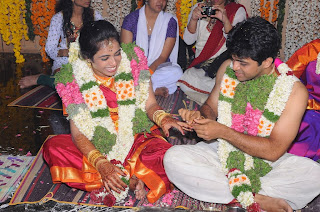
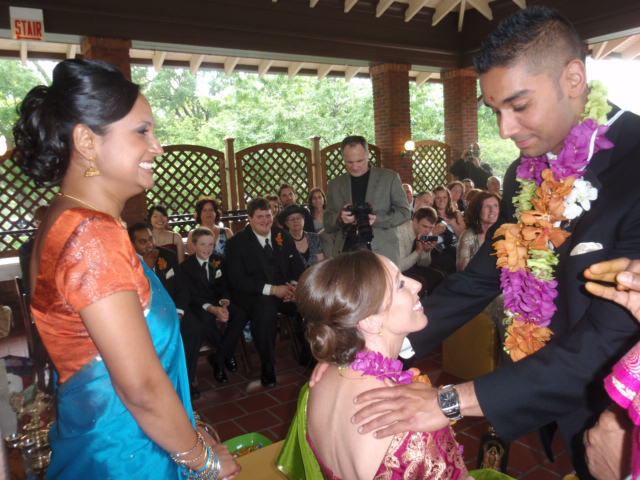
In June, there was such a wedding in Chicago. My grandson Kartik got married to Danielle, his friend of five years. It was a perfect wedding in every sense of the word, a pot-pourri of two cultures. There was no Mappilai Azhaipu, no vritham, no Kasiyathirai, no Mallai Mattal, no oonjal. There was a Sasthrigal (priest) who conducted the wedding in a very dignified manner with the bare essential rites such as the Vinayaka Poojai, the Kappukettal which the Sastrigal himself did both for the bride and the groom, the Kannika Daanam, recital of the Gothram and then the Mangalya Dharanyam or Thali kattu,( the ‘Mundru Mudichu) or Three Knots.

The first two knots were tied by Kartik, while the third knot was tied by Yamini, Kartik’s sister, as is the tradition. Yamini looked lovely dressed in a blue chiffon saree with a matching orange brocade blouse. The bride equally lovely and graceful was wearing a green chiffon sari and a pink brocade blouse, the groom in a tuxedo but no shoes. Next followed the other rites like the Saptha padi, Aseervadham and lastly the Aarathi.

The civil ceremony followed after a break for cocktails. While the guests were enjoying the drinks and meeting other friends, catching up with each other’s news, the bride and her bridesmaids absented themselves. Shortly, all the guests were seated at their respective tables – yes, there were about fifteen to twenty tables seating eight to ten people at each.

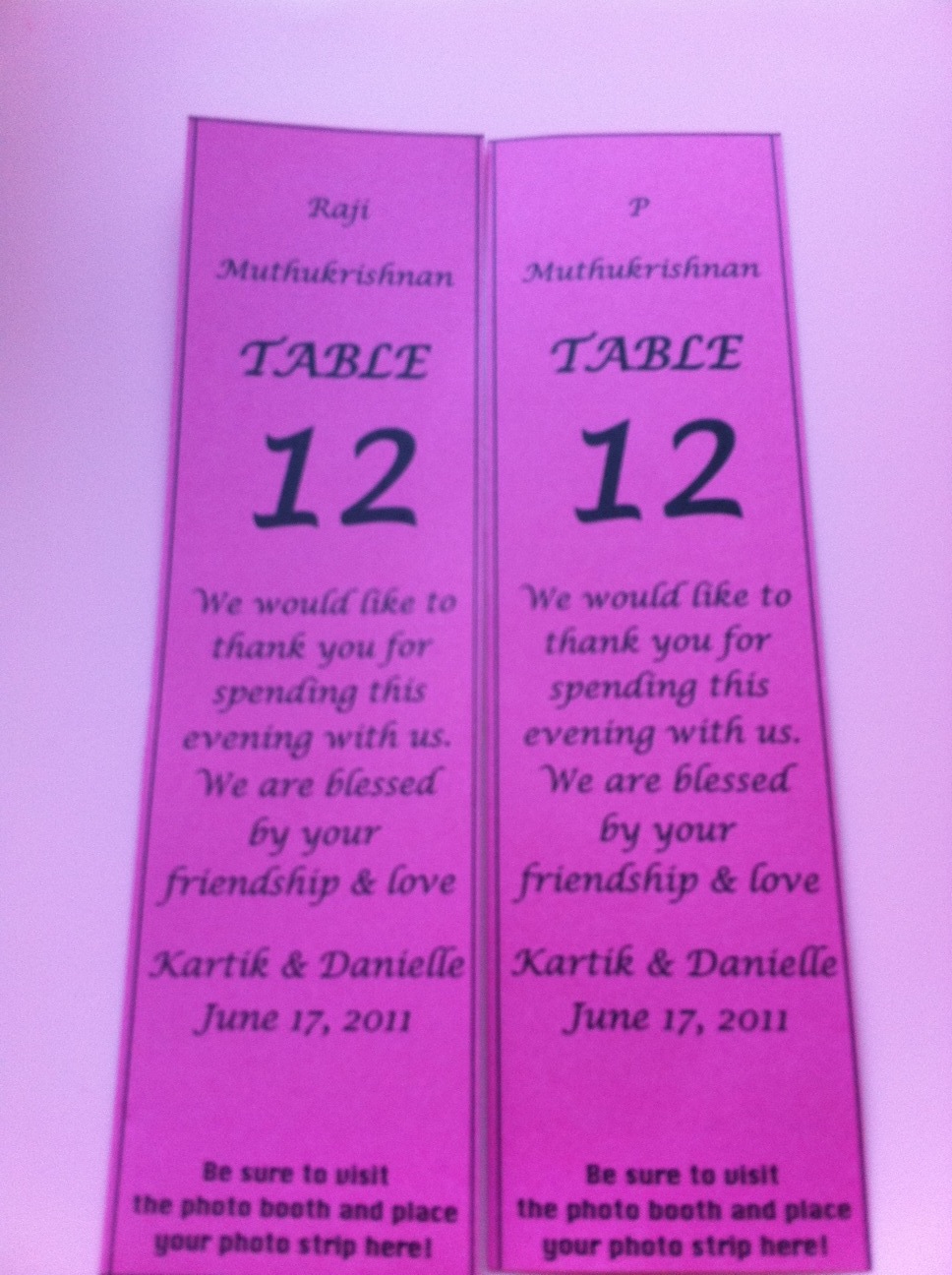
I really appreciated the way the guests were seated. Each table was labeled with the names of the guests, all members of each family in the same table. For example, my children and myself were at one table; the grandchildren were at another table; Jaishree’s mother and her brother, sister and niece with her family at another; known friends together likewise. Each one was made to feel at ease. The food, mainly north Indian, was served on individual plates.

Now, the bride in her really beautiful wedding dress walked down the stairs on her father’s arm followed by the two flower girls and bridesmaids, making a striking entry. From the other side Kartik and his Best Man walked in. It was a beautiful sight. The ceremony was conducted by a padre.

Both Danielle and Kartik took their vows, readily said the two words “I Do” without any hesitation, and exchanged rings. Most eyes (especially those of the parents) turned misty. The newly-married couple exchanged kisses and had the floor to themselves for the first dance as a couple. After this there were speeches, by Kartik thanking every one for their presence, and Jaishree saying a few words about Kartik, about how caring he is to everyone -- in Jaishree’s own words: “A caring son. a caring brother, a caring friend and now a caring husband to Danielle…”

It was then time for every one to get on to the dance floor. Not only youngsters but slightly older couples -- Raji and Muthu, Jaishree and Bala -- also joined them. I felt very happy to see them all enjoying themselves.
I was also thrilled to see three and little girls – seven-year-old Maya and Arundati, and two-year-old Samyukta (three f my great granddaughters) dancing and prancingo all over the place, sometimes by themselves or with any willing partners. Maya’s wish was granted when Kartik found time to dance with her.

Unlike the Washington wedding, for this Chicago wedding there was no need to get anything from India,. There are many outlets in Chicago where one gets all that is needed for any of our functions including the Kalasam and mango leaves!

Two days before the wedding there was a Mehendhi evening organized by Jaishree, in which many relations and friends including the bride’s relations and friends also took part. There were two professionals, girls from India, who did a great job of doing the designs on the hands and feet of children and ladies eager to have it done. Throughout the whole evening there was singing and dancing and merrymaking followed by a very tasty north Indian dinner.


On the wedding eve, Danielle and Kartik hosted a dinner for their relations and friends. This “Rehearsal dinner” (as it is called) for the relations and friends who have come to attend the wedding, was at an Italian place. After the dinner, speeches were made by Bala, Shaun -- one of Kartik’s friends -- and the young brother of Danielle. This was followed by Danielle and Kartik giving gifts to their parents. The bridesmaids too received gifts from the bride. An aunt of the bride was also very generous with her gifts to the parents of the bride and groom, and also to the bridesmaids

The evening and the dinner came to an end with the Ramakrishna clan singing “He’s getting married in the Morning”.

To be continued…..

Saturday, May 21, 2011

BEAUTY

 I am happy to say that this is one of the prize-winning entries at the

Dove & Yahoo! Real Beauty Contest organised by Indiblogger.
 
Beauty means a lot things for me — an old woman who has lived for more than eight decades and has seen, admired and enjoyed so much beauty. Beautiful people,beautiful places, beautiful works of art, and most importantly, beautiful works of Mother Nature.
Beauty in anything is pleasant to the eyes, soothing to the mind and sometimes makes one’s head feel intoxicated . Such is the power of beauty, particularly if it is nature at work. A beautiful face untouched by artificial make-up ( which is very rare these days) is really a sight for tired eyes. A freshly-opened flower with dew drops shining on it makes one wonder about the power of nature! Sunrise and sunset with a few clouds here there reflecting the sunlight in various hues make me even at this age want to hold on to that beautiful scene for ever and enjoy it forever -- as Keats said, “a thing of beauty is a joy forever”.
Beauty lies in the eyes of the beholder is another saying! How true!! A person who has no aesthetic sense will not be able to appreciate beauty in any form or in anything. On the other hand anyone who appreciates beauty will find it lurking somewhere, half -hidden half- submerged in everything around us. I feel that such a person is blessed.
A good- looking gentleman (whose wife was just the opposite) was once asked by a cousin of mine as to how he came to marry her and live with her! “Just look at her with my eyes” was his answer!
“Beauty is what beauty does”. I heard this for the first time when I was a young bride of three four months and that too from my husband’s uncle! By some quirk of fate this uncle had to give up his house and had no place to go. So he turned to us and stayed with us for some time. I really liked him and respected him from the moment I saw him. So his staying with us was no big problem for me. In fact I learned a lot from him to my advantage.
Whenever I put a tasty dish on the dining table he used to say “Beauty is what beauty does”. I had never been bracketed with beauty by anybody before and also I had no illusions about myself. But his saying this gave me so much confidence in myself and in my looks.
Mine was an arranged marriage, as was the custom of those days. The girl and the boy were given a chance to see each other and approve of their parents’ selection for the marriage to be finalised . But my husband and myself were given no such choice. We saw each other only after everything was finalised. Because I knew my limitation I used to tease him that he was not given any chance to say NO.
“Beauty is only skin deep” is very much wrong according to me. I put it as beauty is ‘bone deep ’and also “mind deep’. Bone structure plays a great part in making a face as well as the body look beautiful and attractive. I have come across some Adivasi workers in tea gardens in West Bengal whose facial bone structures and the formation of their skull bones make them very attractive; they have features which are much admired and longed for by the modern urban youngsters.
A beautiful face must go with a beautiful mind. If one’s mind is crowded with ugly thoughts these thoughts somehow show on the face and mar ones looks. Likewise, one should not be vain about one’s beautiful looks. This kind of vanity also reflects on one’s face and kills the beauty there. This is neither preaching nor words of wisdom. One gets to know these facts by experience and with age.
Or by reading the story of Snow White and the seven dwarfs.

Thursday, April 21, 2011

VISHU OF OUR CHILDHOOD


Vishukanni this year at my great-granddaughter Arundati's home in Seattle

 This year, April 15 was VISHU -- the harvest festival, celebrated all over Kerala. Not only just Kerala. All over the world, wherever there is a Keralite, he definitely celebrates Vishu.

Each house in Kerala puts up a Vishukanni the previous night so that members of the family will be able to see it first thing in the morning, as soon as they get up. In every household, this Vishukanni is arranged by the oldest member of the family, in the pooja room, after all the youngsters have gone to bed.      

Vishukanni means the first thing that one’s eyes see on Vishu day. It is all types of auspicious things, arranged, in front of an idol, or picture, of Sri Krishna.  Since this is a harvest festival whatever is grown in one’s garden is placed there as an offering, like, bunches of mangoes, coconuts and jackfruits.  Two brass lamps (nilavillakku) burn brightly on either side, adding to the lustre.


Vishukonnai - Courtesy keralapicturesgallery.wordpress.com

 Bunches of golden-yellow laburnum flowers decorate the display. April is the season when the laburnum blooms in south India. So profusely do they bloom, these trees hang down with their weight – it is a sight not easily forgotten.   And that’s why laburnum is known as Vishukonnai in Kerala.

Gold and silver coins are arranged in rows alongside all these.  Traditionally, these coins would be given to family members and all those who work for it – both in the household and outside. Nowadays, instead of gold and silver coins, cash is given and this is known as Vishu Kaineetam.


On Vishu morning this year, my thoughts went back to my childhood days and the Vishu of those times.  In my younger days, I never saw my mother put up the Vishukanni.  When we children were sent to bed there would be nothing to suggest that we would get a treat -- a  surprise -- the next morning. Yes, the Vishukanni really was a treat for us children. Why children, it was a treat for one and all!!


My first memory of Vishu in our home was when I was four years old. Our mother woke us -- we three sisters and my younger brothers -- early in the morning, even before dawn, and led us one by one with her hands covering our eyes, taking us to the pooja room and seating us.

My father, waiting for us there, poured a rudrani (a small silver spoon) full of water into our cupped palms. We were asked to apply the water to our eyes. Only then were we allowed to open our eyes and look straight into a mirror -- the centrepiece of the Vishukanni, and look at our faces in the reflection.

In our family the traditional Tamil New Year starts on Vishu day. The belief goes the year would be good or otherwise depending on the first face you see as you open your eyes on Vishu day. 

Next our father handed over a gold coin to each one of us, but not for us to keep. We were asked to touch our eyes with it and give it back to our mother.   

After that, each one of us got our Vishu Kaineetam -- one small silver coin called a Panam. Its value was one-seventh of a Rupee, or four Chakrams, for 28 Chakrams made a Rupee.  This was the erstwhile Travancore State’s monetary system and the rupee was called the Sarkar Rupai. (We also had the British Monetary system too, with rupees annas and paisas; this was known as the British Rupai.)  One Panam was just about 15 paisa of today! It was a huge amount for us and we felt very rich.

We did our Namaskarams to God first and then to our parents after which we were let free for the day, to do whatever we wanted.

In the evening, our Athimbar, Mama, as also my mother’s uncles came over to give us Vishu Kaineetam,  a Panam from each to each one of us.  So by the end of the day we felt very, very rich. The rest of the evening was spent thinking what all to buy for ourselves the next day.

In those days a Rupee could get you a lot of things. For instance, a sovereign (gold coin) and a bag of rice (nearly 100 kilos) cost the same, about 12 to 13 rupees.  A six-yard silk sari, woven with a lot of zari all over, cost 12 rupees, a six-yard cotton sari 3 rupees … no wonder we felt we were very rich with a Rupee  each on Vishu day. 

But, and it happened every Vishu, the next morning we felt no need to go and spend our money. So, before going to school, the money would be returned to our mother.

 We had everything we needed thanks to our parents, especially in our mother’s storeroom, which was ever-filled with jars of goodies like murrukku, cheedai, and banana and jackfruit chips, along with sweets made with jaggery (sweets with sugar were rarely made at home on ordinary days).

We children of those days were a happy lot … we were happy walking to our school and back and playing outdoors till darkness fell.  By then we would be ready to eat whatever was given for dinner and go straight to bed dog tired.

Thursday, March 17, 2011

STRINGS OF DEATH

An old  painitng of a tsunami wave by Katsushika Hokusai (circa 18th century).
Mount Fuji can be seen in the background


When natural calamities occur, like the earthquake and tsunami that the people of Japan faced last week, people take strength from one other and try to rescue survivors and hope for the best. No one can be blamed for such occurrences. But it sets  one thinking that this is God’s way of reminding us that there IS a power far beyond our reach, and in no way the humans could compete with Him.

When man-made accidents happen we definitely get angry with the persons who are responsible for such accidents, who take the lives of innocent people. Every morning you open the newspaper to find such headlines ‘Two die in a scooter accident’, ‘Four dead in a truck car collision’,  a train accident, and so on and on . It really makes me angry to read these news items. I think that people in a hurry to reach their destination, just forget to be careful about not only their safety but of others too.

What really made me write this post today is a news item I read in The Hindu two days back.
Four-year-old Saira Banu who  "was travelling home with her parents on a motorcycle suffered a grievous injury when a thread coated with ‘maanja' used to fly a kite slit her throat".

This is very sad, and my heart goes out to the young parents, who must have been full of dreams for the future of their little girl. The story goes on to say that two boys who were flying the kite were arrested along with the men who  sold the  maanja (thread coated with powdered glass) to them. Okay! That is how justice is carried out. Will these arrests bring back their child for the young couple!

This news item reminds me of another such incident that took place years back - a long time back. It happened in an Italian city. A man was going home from work riding his motorcycle. All of a sudden a kite flown by some boys fell down and the Italian equivalent of the maanja string that came down along with the kite found this man in its way! It is difficult to believe, but the string simply went on its way decapitating the motorcyclist

Without losing momentum the motorcycle proceeded on the road with the headless rider!! A man driving his car coming from the opposite direction, shocked to see the headless rider, lost control of his car and crashed into a pickup truck carrying iron rods. He died on the spot. Worse, the sudden impact of the crash dislodged the iron rods. Two of them went right through the windshield of the vehicle coming behind and caused the death of the two front-seat passengers!!

Though it is years back that I read this news, it is etched in my memory with indelible ink because of its frightening ferocity. One can find comfort taking things philosophically. “Oh what to do? It is all predestined.” But what about the survivors? Who will comfort them? Their loss is great for them. Nothing will bring back the dead!

Man-made disasters are more frightening than natural calamities!! This is what I feel. Maybe I am wrong.

Courtesy:http://lhs.lexingtonma.org/teachers/cordero/kiteproject/flying.html